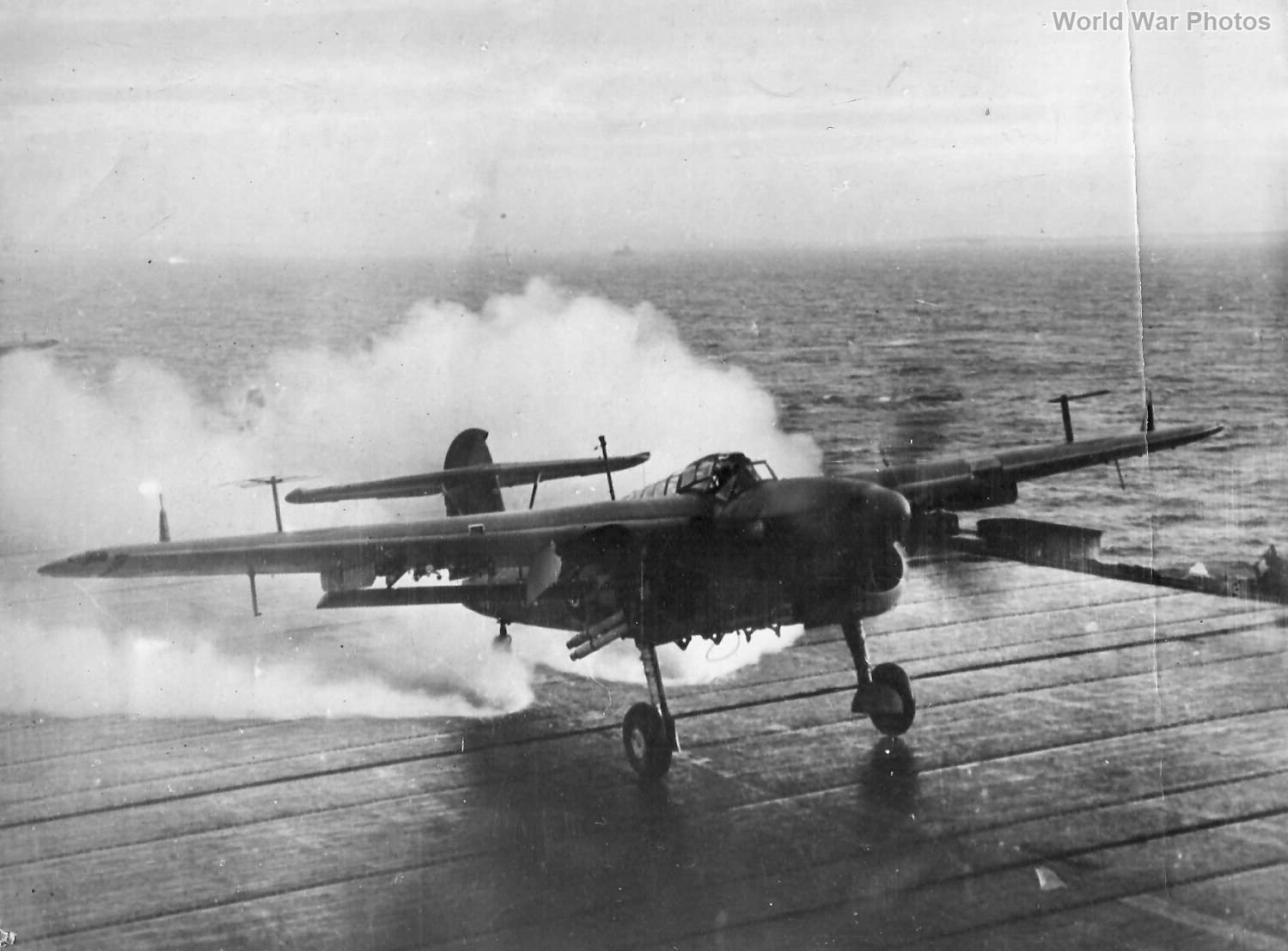
Barracuda with Rocket-Assisted Take-Off Gear
The Barracuda’s poor take-off performance, particularly when operating from escort carriers, was a significant concern. To address this, the Royal Aircraft Establishment (RAE) explored several solutions, with two key innovations: Rocket-Assisted Take-Off Gear (RATOG) and catapult launching systems.
Rocket-Assisted Take-Off Gear (RATOG):
RATOG was designed to boost the Barracuda’s take-off capability, especially when heavily laden with bombs or torpedoes. The system involved attaching two solid fuel rocket motors to the sides of the fuselage. These rockets were angled outward to ensure that their thrust aligned with the aircraft’s center of gravity, minimizing any unwanted trim changes during take-off.
Operation:
- The pilot would activate the rockets electrically from the cockpit as the aircraft passed a designated marker on the carrier deck. The rockets provided a significant acceleration boost, which lasted until shortly after take-off, ensuring the aircraft was airborne before the rockets burned out.
- Once the aircraft was safely in the air, the entire RATOG system could be jettisoned.
First RATOG Test:
- The first successful RATOG-assisted take-off was conducted by Lt. Eric Brown in a Barracuda II, serial number P9791, from the escort carrier HMS Pretoria Castle on 1 August 1944.
- Following successful tests, RATOG became standard operating procedure for Barracudas taking off from escort carriers, particularly when they were heavily loaded.
Catapult Launching Systems:
In addition to RATOG, improvements were also made to the catapult launching systems used on carriers. There were two primary methods: the British cradle system and the American wire strop system.
- British Cradle System:
- The British system involved a cradle that supported the aircraft via four spools mounted on the fuselage. During a catapult launch, the aircraft was released in a level flight attitude and then had to be rotated into a climbing position by the pilot.
- American Wire Strop System:
- The American system, tested and eventually adopted for the Barracuda, used a simpler and more efficient method. A single wire strop was attached to the flight deck, running through a catapult slot, with the other end connected to a single hook under the aircraft’s fuselage. The tail of the aircraft was secured (tail down) by this strop through a retaining ring.
- When the catapult launched the aircraft, the pressure would eventually break the retaining ring, allowing the shuttle to move forward. At the end of its run, the shuttle would stop, and the strop would slip clear from under the aircraft, allowing it to accelerate away in the correct flying attitude.
- Testing and Adoption:
- The Barracuda II, serial number DR126, was used to test the American system aboard HMS Pretoria Castle on 3 April 1945. This testing included various load configurations, such as carrying a torpedo.
- The successful tests led to the adoption of the American wire strop system as the standard launching procedure for Barracudas.