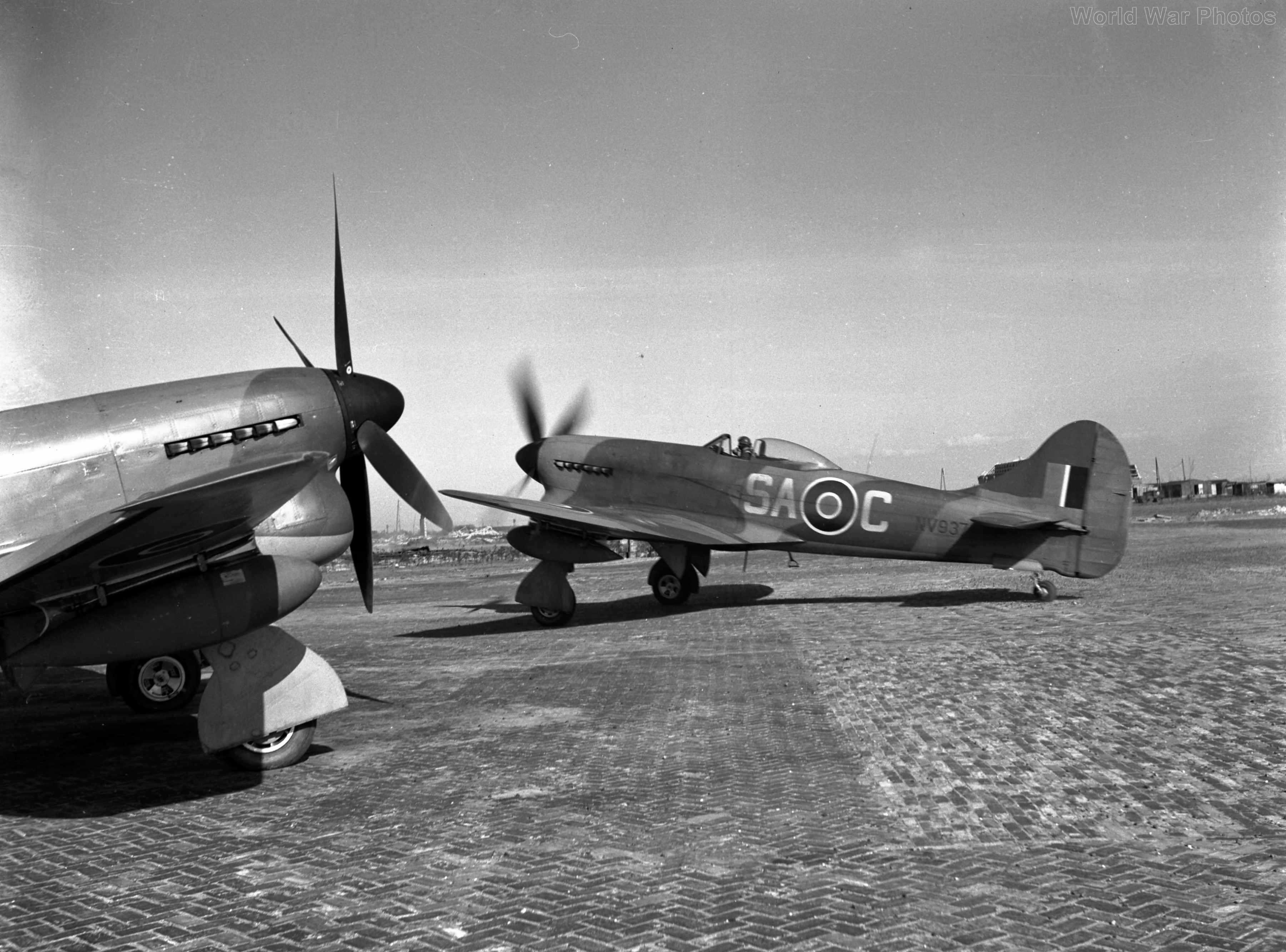
Tempest NV937 SA-C Volkel 1945
The Hawker Tempest was designed to significantly improve upon the Hawker Typhoon’s performance, particularly by addressing the Typhoon’s wing section limitations at high speeds. This led to the development of a new thin wing with a root thickness/chord ratio of 14.5 percent, tapering to 10 percent at the tip, and a maximum depth occurring further back at 37.5 percent chord. This design modification aimed to resolve the severe buffeting and aileron reversal tendencies encountered by the Typhoon when diving at speeds around 500 mph, which made accurate gun aiming impossible.
Upon its entry into service, the Tempest was recognized as the most potent medium- and low-level fighter yet acquired by the RAF. Early trials revealed that the Tempest, particularly the Mark V, was faster than all contemporary Allied and German fighters below 20,000 ft. It demonstrated speeds 15-20 mph higher than Allied types like the Mustang III and Spitfire XIV, and 40-50 mph faster than German aircraft such as the Bf 109G and Fw 190A at these altitudes. For instance, a Tempest V achieved a maximum speed of 376 mph at sea level and 432 mph at 18,400 ft, with a “very useful” 411 mph recorded at 6,600 ft. The Tempest Mark II, powered by a Bristol Centaurus engine, was even faster, reaching 442 mph at 15,200 ft.
The Tempest’s operational effectiveness was significantly boosted by its high cruising speed and remarkable acceleration in the dive, which greatly facilitated interceptions. It was also noted for its steadiness as a gun platform, making its four 20 mm Hispano cannons highly accurate. Pilots described its climb as “like rockets” and its dive at “incredible speeds”. While it could be out-turned by more agile aircraft like the Mustang and Spitfire, the Tempest could hold its own in a turn against the Fw 190 and out-turn the Bf 109.
A major role for the Tempest was its “unmatched low-level performance” in defending against the V1 flying bombs. Its speed allowed it to intercept these fast, low-flying targets, and it was even faster than the early Gloster Meteor jet fighters deployed during the V1 attacks. To enhance its effectiveness against the small, fast-moving V1s, Tempest cannons were harmonized to hit a specific point at 300 yards, leveraging the aircraft’s stability as a gun platform. Efforts to improve its low-level speed included refining the wing’s surface finish and increasing engine boost, with the removal and smooth repainting of “D-Day stripes” alone adding approximately 10 mph to its maximum speed at low level.
Beyond its defensive role, the Tempest’s main operational role in the 2nd Tactical Air Force shifted to “armed recces” (armed reconnaissance) and ground attack. It was particularly well-suited for these missions due to its speed, heavy firepower, long range, and excellent pilot vision. Tempests were highly successful in damaging German infrastructure, including hundreds of locomotives and vehicles, often engaging targets at low levels from a 25-30 degree dive. However, these low-altitude ground attack missions were hazardous, with nearly half of all Tempest losses in the 2nd TAF attributed to flak.
In air combat, the Tempest achieved a high kill/loss ratio against German propeller-driven fighters. It also demonstrated notable success against the Luftwaffe’s new jet aircraft, destroying at least eleven Messerschmitt Me 262s, a tally unsurpassed by any other Allied fighter. Although the Tempest could not always outrun an Me 262 even with a height advantage and a dive, successful tactics involved ambushing the jets during their vulnerable take-off and landing phases.
Overall, the Tempest’s advanced design and powerful engines ensured its continued relevance and effectiveness throughout its service life, adapting from a pure fighter to a versatile fighter-bomber capable of excelling in anti-V1 operations, ground attack, and air-to-air combat at low to medium altitudes.