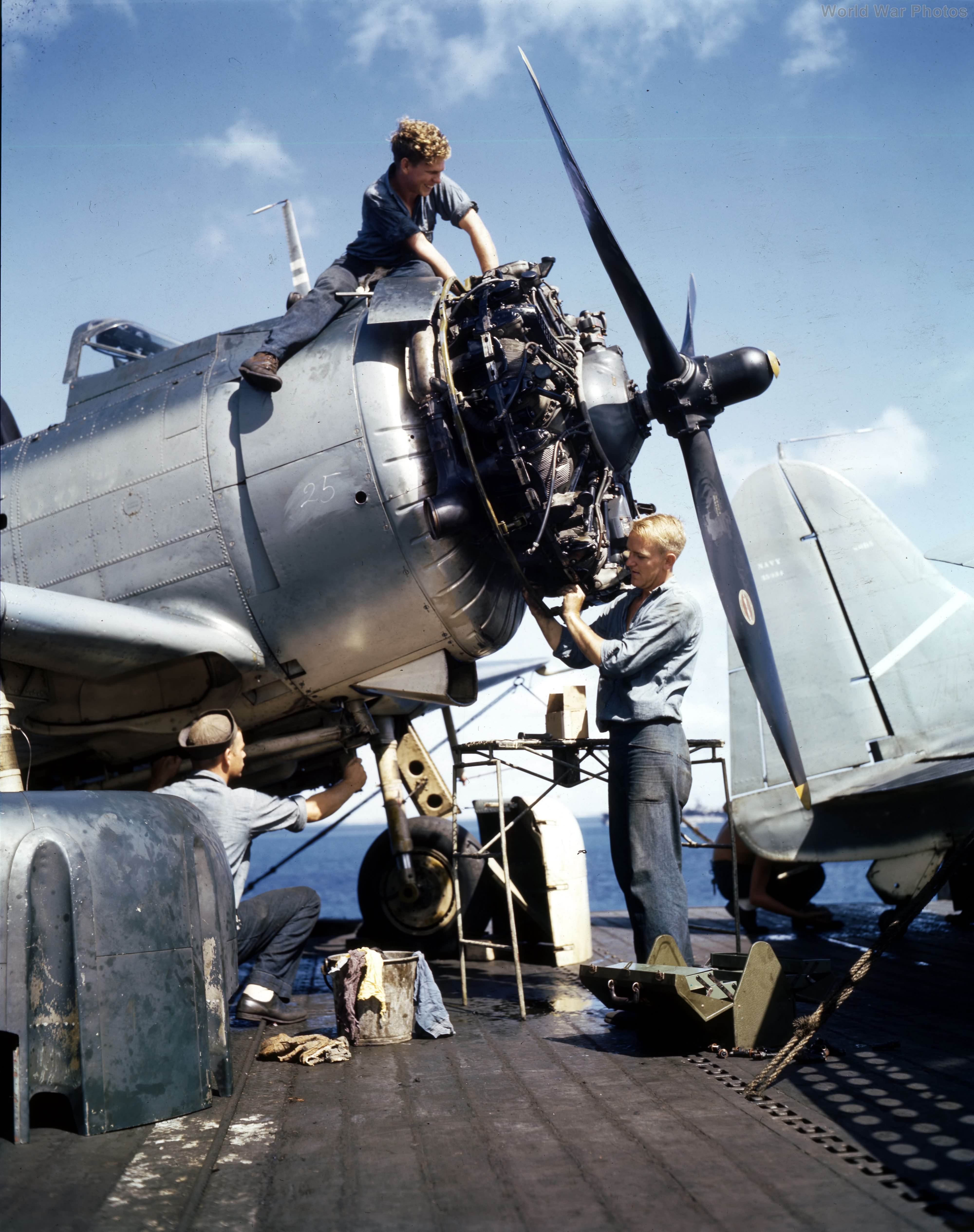
Mechanics overhaul Wright R-1820 Cyclone engine
All versions of the SBD Dauntless and its Army variant, the A-24 Banshee, were powered by the Wright Cyclone R-1820 nine-cylinder radial engine. The progression of engine models and their specifications are as follows:
– SBD-1 and SBD-2 : Utilized the Wright Cyclone R-1820-32, rated at 800 hp.
– SBD-3 : Equipped with the Wright Cyclone R-1820-52, rated at 1,000 hp. This engine supported additional armor plating and self-sealing wing tanks, which increased the aircraft’s weight.
– SBD-4 : Continued to use the R-1820-52 with no significant weight increase compared to the SBD-3.
– SBD-5 : Upgraded to the Wright Cyclone R-1820-60, rated at 1,200 hp, which handled a weight increase of 220 lbs.
– SBD-6 : Featured the R-1820-60, but with a further increase in power to 1,350 hp, supporting an empty weight of 6,554 lbs.
Engine Specifications:
The Wright Cyclone R-1820 engine is an air-cooled, single-row, nine-cylinder radial engine. Key operational requirements and components include:
– Fuel : Required 100/130 fuel to Specification AN-F-28.
– Lubricating Oil : Grade 1120 manufactured to Specification AN-W-0-446.
– Propeller : The SBD-1 to -3 used a Hamilton Standard constant speed propeller, while the SBD-4 to -6 used a Hamilton Standard Hydromatic propeller. The propeller was driven by the engine with a reduction ratio of 3 to 2.
– External Systems :
– Hamilton Standard speed governor
– Bendix-Stromberg injection carburetor with an electrically controlled primer
– Two Edison-Splitdorf magnetos
– Cuno oil filter
– Inertia hand-operated starter
Engine Controls and Cowling:
– Controls : All engine controls were centered in the pilot’s cockpit, with the throttle duplicated in the gunner’s cockpit.
– Anti-Drag Ring Cowling : This three-part assembly, manufactured of slightly thinner metal in the SBD-6, allowed for improved center of gravity by moving the engine slightly forward. The assembly used Dzus fasteners and spring toggles, supported by rubber pads bolted to the front of the cylinders.
– Cowling Flaps : Hydraulically-operated cowling flaps were attached to the rear of the support ring, with the remaining panels fixed in position.
Douglas Aircraft’s engine policy for the Dauntless was characterized by providing engines that were sufficient but not leading in power output. The rationale behind not opting for engines at the forefront of the power curve remains unclear. Despite this, the Dauntless’s combination of airframe and engine specifications provided reliable service throughout its operational history. By maintaining a consistent engine model across different versions, the SBD Dauntless and A-24 Banshee could balance performance with the increasing demands for additional armor and payload capacity as the aircraft evolved.