
Char 2C 93

Char 2C 91
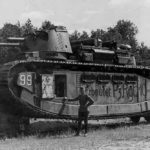
Char 2C 99 6

Char 2C 4

German troops with French Char 2C 99 Champagne

German soldiers posing with a Char 2C 99 “Champagne” in Luneville
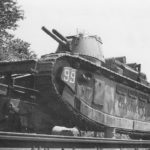
Char 2C 99 3

Char 2C 98 2

Destroyed Char 2C

Char 2C 99 “Erbeutet vom PzRgt.10”

French tanker mans Hotchkiss machine gun, interior

Char 2C 99 5

Char 2C 99
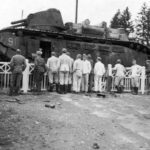
Char 2C 91 “Provence” 1940

Char 2C 92 “Picardie”

Char 2C 92 rear

Char 2C 99 2

German soldiers examines the wreckage of the “Berry”

Char 2C 91 3

Char 2C 99 4
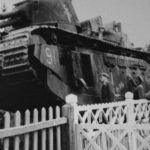
Char 2C 91 2

French super heavy tank Char 2C number 91 Provence

Captured by German forces Char 2C (FCM 2) tank, side view

CHAR 2C (FCM 2) tank top view of the turret

Captured french super heavy tank Char 2C 1940

French super heavy tank Char 2C front view

French super heavy tank Char 2C number 99 Champagne, Meuse 1940 (ex 51e Bataillon de Chars Lourds)

Captured French super heavy tank Char 2C, 1940
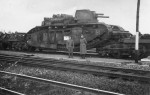
German soldiers posing with a captured Char 2C number 91, Meuse 1940

German officers atop a French super heavy tank Char 2C

A group of German soldiers posing with a captured French tanks

Char 2C tanks. Tank was transported aboard special low-loader waggons for carriage by rail.

Char 2C number 99 (“Champagne”) France 1940. The Germans captured this tank almost undamaged.

French super heavy tank FCM 2C number 96, named “Anjou”, France 1940
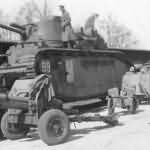
Superheavy tank Char 2C “Champagne” number 99, before transport to Germany
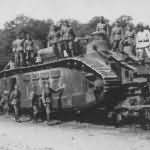
Char 2C FCM captured during transport
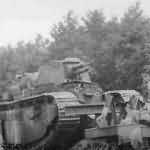
Damaged superheavy tank Char 2C, rail transport, 1940

Upper view of a French super heavy tank FCM 2C, France 1940

Char 2C FCM number 95 named “Touraine”, Mairy-Mainville 1940

Char 2C FCM Number 95 – Mairy-Mainville France 1940

Char 2C number 98 “Berry” of the 51e Bataillon de Chars Lourds

Char 2C number 98 of the 51e Bataillon de Chars Lourds
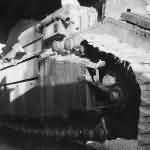
Char 2C, Luneville France 1940
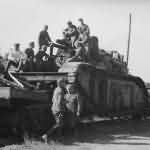
Char 2C captured by germans
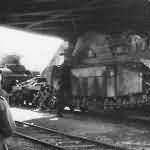
Captured Char 2C tank, Troyes France 1940

Shell holes in the turret of a destroyed French Char 2C
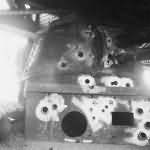
FCM Char 2C Luneville 1940
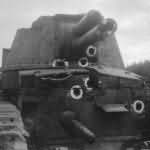
Detail of the turret of heavy tank Char 2C, France 1940

Super heavy tank Char 2C FCM, number 92 “Picardie” and Wehrmacht soldiers
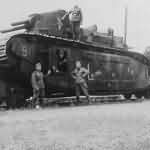
Char 2C number 91 “Provence”, french superheavy tank
History
The exact history of the design of this tank is shrouded in mystery. By the spring of 1918, just three years after the start of the design of the first French tank, a French parliamentary commission began investigating the designing of tanks at that time and found it impossible to reach even the most basic documentation. It became evident at that time that someone in a very active manner systematically destroyed existing documents, thus obliterating the traces of his participation in this first “tank scandal”, comparable to that in England in 1944. On the basis of the surviving documents, the following course of events has been reconstructed: in the summer of 1916 the shipyard FCM, in Brittany, France, was contracted to design and build a heavy tank by bribing General Mouret (former head of the army automotive department) Although never before planned such a project. After obtaining government grants, FCM does nothing to fulfill its obligations.
When on September 15, 1916, British tanks appeared at the battlefield for the first time, with unexpected success, French public opinion began to demand information on the state of France’s preparations for tank production. This was disturbing to General Mouret, who knew nothing about it. After a brief investigation he learned, to his surprise, that the FCM had not done anything about it yet. On 30 September he decided to take matters into his own hands and held a meeting with Louis Renault, begging him for help – Renault agreed.
Louis Renault then consulted with his own design team, who had just completed the revolutionary Renault FT-17, and was pleased to learn that his most talented engineer, Rodolphe Ernst-Metzmaier, had already begun the design of the tank. The wooden model of the natural size of such a tank was quickly constructed, and was presented to the Comité consultatif de l’artillerie d’assaut on January 17, 1917. The design of this tank was by far the most modern and advanced construction in the world. This, in turn, raised concerns about General Estienne, commander of newly formed armored units, who feared that launching these tanks would slow down or even stop the production of much more practical (and cheaper) FT-17s. He convinced the Commander-in-Chief of French forces General Joffre to cancel the design of the tank. However, General Mouret ordered three prototype variants of the new tank – the “A”, “B” and the “C” versions, which weighed 30, 40 and 62 tonnes, respectively.
In December 1917, the first prototype, the FCM 1A, was unveiled. At that time, Mouret lost any political influence and Estienne became head of the commission. A close friend of Estienne, General Philippe Pétain suggested him to complete this “dangerous” program. Estienne replied that it would be politically dangerous because the French public wants to know why these heavy tanks are not yet ready, suggesting they would support the construction of these vehicles publicly, but behind the scenes they were doing everything possible to delay their uprising. Estienne then chooses the heaviest “C” version, which requires a new prototype, further delaying production, and in the Pétain issue will lie to place an impossibly large order, further delaying production and thus launching new political scuffles.
Pétain orders 300 heavy tanks and sets a delivery date for March 1919, which begins an immediate quarrel between the Prime Minister and the War Minister Clemenceau and Minister of Armaments Louis Loucheur, who is already having trouble finding the right production capacity and materials for his existing orders. Over the next few weeks and months, Estienne and Pétain are beginning to demand the most ridiculous improvements to the tanks to make their production completely unprofitable and unrealistic. Pétain asks to produce pontoon dinghies so that the tanks can cross the Meuse River, the Rhine River and the Elbe River, and Estienne wishes to add a taran and an electronic mine detector to the tank. Until the end of the war, no one tank was completed.
It is decided to cancel the order and for a short while it seems that the history of the French heavy tank will end up like a farce, but ultimately Estienne decides to order 10 tanks that are finally created in 1921.
In 1926, “Champagne” was converted to the Char 2C bis, which instead of the four MGs received a 155 mm howitzer. This conversion was only test-proof, already in the same year the tank was transferred to the original state.
In 1939, “Lorraine” was armed in order to withstand the German anti-tank guns. For this, the front armor was increased to 90 mm and the side armor to 65 mm. This was the strongest armor at this time probably making “Lorraine”, weighing 75 tons, the heaviest tank ever to be operated.
At the beginning of the Second World War, all 10 tanks built by Forges et Chantiers de la Méditerranée were operational. They were grouped together in their own tank battalion, the 51e Bataillon de Chars Lourds. The tanks were then already obsolete, slow and too easily vulnerable, but were still used for propaganda purposes. For this purpose they have been named after historical provinces of France.
The tanks were deliberately not used in battle. After the Third Reich had broken through the French lines during the Western Campaign, the decision to move the Char 2C southward on June 10th, 1940, fell. The transport train was stopped by a burning train on June 15, 1940, and the tanks had to be demolished to prevent them from falling into the hands of the Germans. German propaganda spoke of a Stuka attack. A tank “Champagne”, more or less functionally, was captured and taken to Berlin.
Specifications
Weight: 69 t, length: 10.27 m, height: 4.09 m, width: 3 m. Tank crossed trenches of 4,25m, climbed obstacles 1,7m high, and forded 1,4m streams. Ground clearance: 0,6m. Range: 150 km, max speed: 12–15 km/h.
Armour: 45mm front, 35mm forward turret, 22mm sides, 13mm top, 10mm bottom, 22mm rear turret.
Crew: 12 tankers.
Total production: 10 tanks.
Plastic model kits
1/35: Meng TS-009 CHAR 2C FRENCH SUPER HEAVY TANK; 544 parts
Reference
Captured French Tanks Under the German Flag – Werner Regenberg, Horst Scheibert – Schiffer Military History 1997
French tanks of World War II (1), Infantry and Battle Tanks – Steven J. Zaloga – Osprey New Vanguard 209
Le Char 2C – Musee des Blindes MiliDoc 02 (french)
French Infantry Tanks: Part I (Chars 2C, D and B) – AFV Weapons 58
World War II Album Volume 10: French Tanks Char B1 – Char D1 – Char D2 – Char 2C – Ray Merriam 2015