Click on thumbnail images to enlarge

The Heinkel He 162 (“Volksjäger”, “Salamander” or “Spatz”) was a German single-engine, jet-powered fighter used by the Luftwaffe in World War II. Fighter was designed by engineer Siegfried Günther. Spatz was Heinkel’s response to an RLM demand for a single-seat, powered by a single BMW003 engine, cheap and expendable jet fighter, fast and good armed to deal with the impact of Allied bombing of German industries.
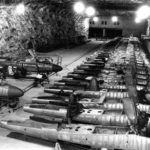
Assembly line of the He 162 at Eger near Salzburg 1945
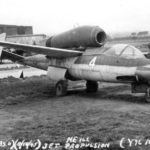
He 162 white 4 W.Nr. 120067 at Kassel-Waldau airfield Y-96 1945
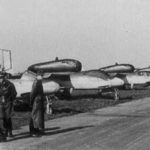
Jet fighters Heinkel He162 at Leck May 1945

Heinkel He 162 Volksjäger 220003 M20 at Munich-Riem
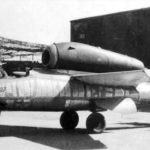
He 162 A-1 Volksjäger Werknummer 300027, 1945

Heinkel He162 white 23 120230 and 120233
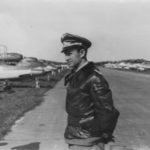
He 162 pilot Oberleutnant Karl-Emil Demuth – Leck 1945. White 4 in the background
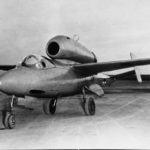
He162 V-1 Volksjäger prototype, 1944
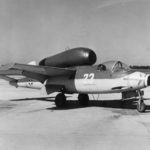
Heinkel He 162 white 23 120222, USA 1945
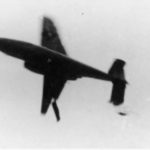
Heinkel He 162 V1 Volksjäger in roll just before crash.

He162 and pilots of the I/JG 1, 8 May 1945
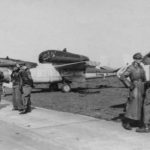
He 162 Spatz of the JG 1 at Leck 1945
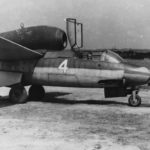
Captured Heinkel He 162 white 4 W.Nr. 120067 ex JG 1 at Kassel-Waldau 1945

Heinkel He 162 A-2 Spatz W.Nr. 120222
The Heinkel He 162 (“Volksjäger”, “Salamander” or “Spatz”) was a German single-engine, jet-powered fighter used by the Luftwaffe in World War II. Fighter was designed by engineer Siegfried Günther. Spatz was Heinkel’s response to an RLM demand for a single-seat, powered by a single BMW003 engine, cheap and expendable jet fighter, fast and good armed to deal with the impact of Allied bombing of German industries.
General Description
- Type: Single-seat jet-propelled fighter.
Wings
- Configuration: Shoulder-wing cantilever monoplane with a 3° dihedral and an aspect ratio of 4.65.
- Structure:
- All-wood structure, one-piece design attached to the fuselage with four bolts.
- Features a straight leading-edge, blunt detachable metal tips, and a pronounced sweep forward on the trailing edge.
- Main and auxiliary T-section spars with plywood covering (5 mm thick between spars on the upper surface and 4 mm elsewhere).
- Space between spars serves as a fuel tank.
- Hydraulically-controlled metal flaps between fuselage and ailerons, with a maximum depression of 45°. Ailerons move 18° either way.
Fuselage
- Construction:
- Semi-monocoque structure with flush-riveted duralumin, and a plywood nose.
- Contains steel fittings and inspection covers made of duralumin or wood.
- Aerodynamically clean design, with an oval nose section, pear-shaped central portion, and circular rear section.
- Tail cone adjustable in flight to modify tailplane incidence from +3° to -2°.
Tail Unit
- Type: Cantilever monoplane with mixed construction.
- Structure:
- Tailplane, elevators, and rudders are of duralumin construction with steel fittings. Wooden fins bolted to the extremities of the tailplane.
- Tailplane set at a moderate dihedral and has constant chord.
- Elevators feature fixed tabs at their inner ends; rudders are fully mass-balanced, have fixed tabs above the tailplane, and can move 25° either way.
Landing Gear
- Type: Retractable tricycle type.
- Main Wheels: Similar to Me 109, retract into fuselage. Features hydraulic retraction and spring lowering. Openings covered by mechanically-operated plywood doors.
- Nose Wheel: Retracts backward into fuselage nose, has slight castor action, and an anti-shimmy device.
Power Plant
- Engine: One BMW 003 E-1 turbo-jet unit centrally mounted on top of the fuselage.
- Alternatives: Could include BMW 003 E-2, Junkers Jumo 004, or Heinkel-Hirth 011.
- Fuel: Uses J-2 diesel fuel with a maximum capacity of 168 Imperial gallons in the fuselage and 40 gallons in the wings.
Accommodation
- Cockpit: Pilot’s cockpit located in the nose, forward of wings. Entry and exit through a canopy that opens rearwards and can be jettisoned.
- Special Features: Pilot-ejecting seat actuated by an explosive cartridge. Plywood instrument panel.
Armament
- Options:
- Either two 30 mm MK 108 cannons with 50 rounds per gun.
- Or two 20 mm MG 151/20 cannons with 120 rounds per gun.
- Mounting: Armament mounted low in the fuselage sides.
Dimensions
- Span: 23 ft. 7.5 in. (7.2 m)
- Length: 29 ft. 8.5 in. (9 m)
- Wing Chord (Root): 6 ft. 8.5 in. (2.06 m)
- Tailplane Span: 7 ft. 5.5 in. (2.3 m)
- Tailplane Chord: 2 ft. 8.5 in. (0.84 m)
Weights
- Normal Loaded Weight: 5,480 lbs. (2,490 kg)
- Maximum Fuel Loaded Weight: 5,940 lbs. (2,700 kg)
- Landing Weight: 4,820 lbs. (2,190 kg) with 20% fuel
- Wing Loading at Landing: 40 lbs./sq. ft. (18.2 kg./sq. m)
Performance
- Maximum Speeds:
- 490 mph (784 km/h) at sea level
- 522 mph (835 km/h) at 19,680 ft. (6,000 m)
- 485 mph (776 km/h) at 36,000 ft. (10,980 m)
- Climb Rates:
- 4,200 ft./min (1,280 m/min) at sea level
- 2,460 ft./min (750 m/min) at 19,680 ft. (6,000 m)
- 690 ft./min (210 m/min) at 36,000 ft. (10,980 m)
- Time to Altitudes:
- 6.6 min to 19,680 ft. (6,000 m)
- 20 min to 36,000 ft. (10,980 m)
- Full-throttle Ranges:
- Normal fuel: 136 miles (220 km) at sea level, 267 miles (430 km) at 19,680 ft., 410 miles (656 km) at 36,000 ft., 434 miles (695 km) at 38,400 ft.
- Maximum fuel: 242 miles (390 km) at sea level, 620 miles (1,000 km) at 36,000 ft.
- Full-throttle Endurances:
- Normal fuel: 20 min at sea level, 33 min at 19,680 ft., 67 min at 36,000 ft.
- Maximum fuel: 30 min at sea level, 85 min at 36,000 ft.
- Ceiling: 39,400 ft. (12,020 m)
- Take-off Run:
- Normal fuel: 710 yards (650 m) or 350 yards (320 m) with auxiliary take-off units
- Maximum fuel: 875 yards (800 m) or 415 yards (380 m) with auxiliary take-off units
- Landing Speed: 102 mph (163 km/h)
Bibliography
- Peter W. Cohausz:- Deutsche Flugzeugcockpits und Instrumentenbretter Teil 6. Zweiter Weltkrieg Heinkel – Junkers, Cockpit Profile 6
- J. Richard Smith, William Conway: The Heinkel He 162, Aircraft Profile Number 203
- Robert Forsyth, Jim Laurier: He 162 Volksjäger Units, Osprey Combat Aircraft 118
- Heinz J. Nowarra: Der “Volksjäger” He 162, Waffen-Arsenal 85
- Heinz J. Nowarra: Heinkel He 162 “Volksjäger” He 162, Schiffer Military History
- Janusz Ledwoch: He 162 Volksjäger, Wydawnictwo Militaria 44 (polish)
- Miroslav Bily, Miroslav Balous: Heinkel He 162 Spatz (Volksjäger), MBI (czech)
- Robert Forsyth: Heinkel He 162 – From Drawing Board to Destruction: The Volksjager Spatz
- Flugzeug Profile 35: Heinkel He 162
- Ernst Heinkel Flugzeugwerke 1933-1945
- Manfred Griehl: Heinkel Combat Aircraft, Arms & Armour Press
- Heinkel: Chronik und Typenblatter der Firma Heinkel-Flugzeugbau
- Volker Koos: Heinkel Raketen- und Strahlflugzeuge (german)
- Manfred Griehl: German Jets 1944-1945, Luftwaffe at War 10
- Manfred Griehl: German Jets of World War Two (Warbirds Illustrated No.52)
- German Jets in W.W.II – Model Art Modeling Magazine 348 (Japanese)
- Brett Green: Modelling Luftwaffe Jets and Wonder Weapons – Osprey Modelling Masterclass
- J. Richard Smith, Eddie J. Creek: Jagdwaffe – Jet Fighters and Rocket Interceptors 1944-1945, Luftwaffe Colours – Volume Five Section 4
- Jean-Denis G. G. Lepage: Aircraft of the Luftwaffe, 1935-1945 An Illustrated Guide
- Peter Müller: Heinkel HE 162 “Volksjäger” Last Ditch Effort by the Luftwaffe
- Dan Sharp: The Hated Volksjäger: Histories of the Heinkel He 162
- Manfred Griehl: The Luftwaffe Profile Series No.16 – Heinkel He 162 ,Schiffer Military History Book
- Shigeru Nohara, Masatsugu Shiwaku: Messerschmitt Me 163 & Heinkel He 162 – Aero Detail 10 (japan)
- Wolfgang Wollenweber: Thunder Over the Reich: Flying the Luftwaffe’s He 162 Jet Fighter
- Maciej Goralczyk, Jacek Pasieczny, Simon Schatz, Arkadiusz Wrobel: Last Hope of the Luftwaffe: Me 163, He 162, Me 262, Kagero Mini Topcolors 37
- J. Richard Smith, Eddie J. Creek: Monogram Close-Up 11 – Heinkel He 162 Volksjager
- Wolfgang Peter-Michel: Flugerfahrungen mit der Heinkel He 162 (german)
- David Myhra: Heinkel He 162 – X Planes of the Third Reich Series